Turn your phone sideways to read the slides
PTW Palace, Lisbon · 9 November 2026
AI Adoption in 2026
What Worked, What Didn’t — Design Studio POV
A team of 7 people spent a year building its own AI system. What worked, what didn’t, and what it cost.
Motka
Design studio founded in 2005.
300+ projects. UX/UI and branding.
The Team
Art-Directors (2), Senior Designers (3),
Managers (2) + 9 freelance designers.
About Phil Smirnov
Digital designer since 1996.
Art-Director at Gazeta.ru 1999–2005.
In This Talk
A single studio, a single year of studying AI. Honest recap.
- Why did we get spooked in the first place?
- 6 weeks of AI Lab
- What came out of the Lab?
- 7-step method: how to build this for yourself or for a client
- How the AI reality kept changing in 2026
- Where we are now, and what it actually gave us
- What didn’t work
Also: ChatGPT Images 2.0 · Recraft · Leonardo
Fear of Missing Out
Nov–Dec 25
Claude Code starts writing code flawlessly
Jan
Figma MCP
Feb–Apr
AI Lab
6 weeks · the core team of 7
May–Jul
Figma MCP Server gets developed
Aug
Figma AI
Sep–Oct
Full Claude ↔ Figma MCP
Wave 1 — everything except design
Wave 3 — New flow
Nov
Dec
Jan
Feb
Mar
Apr
May
Jun
Jul
Aug
Sep
Oct
Wave 2 — Figma through Claude, ChatGPT Images 2.0
Nov 2025 → Nov 2026
7 people — 7 different routes into AI
AI Lab: Let All Flowers Grow
6
weeks
12
sessions: theory and practice
7
core team members
2
kinds of projects
Claude Code only
Resources not counted
Drop anything, any time
Nobody was pushed
Design studio projects
- Case retrieval
- Proposal builder
- Generate design system from layout
- Generate Figma mockup from HTML
- HTML page builder for website
- Motka’s own history (Wiki RAG)
Personal projects
- A dog training scheduler for the rescue team
- A personal task tracker
- Curriculum builder
- Real estate property search
- A tax return inquiry (the lab’s first payoff)
- Figma -> Webflow plugin
Feb — Apr 2026
Actual design production did not get any faster. Everything around production did.
After the Lab
Still doing by hand
Design in Figma
6 weeks of lab, and not one layout moved to a model. Every screen was still drawn by a person, from the first frame to the last pixel.
The reason was the tooling of that moment.
The Figma link was HTML → Figma conversion only: generate in Claude first, then convert, then repair.
Nothing direct existed yet.
Doing together with AI
Project Management
- Call transcripts
- Task summaries
- Writing commercial proposals
- Answering inbound inquiries
- Brainstorms
- Our own website (dropped Webflow)
Time from an inbound email to the first proposal, from a finished call to a task list, from the idea to a posted text — shortened from days to minutes.
State of AI at Motka in April
Q: How do we keep shared context about Motka in a shape every one of us can use?
20 Years of Design Studio Life
inspired by A. Karpathy’s wiki-RAG
Web archive only
Google Drive — briefs, specs, proposals, memos
Basecamp
Slack — daily activity
Telegram & WhatsApp chat dumps
Notion
2005
2010
2015
2020
2025
No memory back then — sessions kept overflowing
In fact everyone was building their own private garden
Claude is a personal tool, not a collective space
Context Engineering
—
1st fail: Tried pointing Claude at the whole Google Drive.
Burnt 3 daily limits. Got nothing.
—
Sorted it out myself in 1.5 hours.
It worked because my own human filter was already pre-trained.
—
A machine does not know which document matters and which piece of text never did. Only a human does.
—
The reading rules: where to read and where not to
(for Slack, for email, for chat archives)
—
The goal: curated long tail of Motka history that lives in the wiki.
Fresh project context goes in with the prompt.
The wiki is a constant for every project.
—
A single source of truth shared across the team in the form of a skill
Feed the machine
the cleanest context possible.
Everything after this step depends on it.
Our Method of 7 Steps
00
Seed context
01
Tone of Voice
02
Layers of Truth
03
Wiki
04
Entities.db
05
Facts Enrichment
06
Gates + Checks
07
Sync & Replication
Where most people fail:
The barrier isn’t the tool.
It’s that there is no obvious 1st move.
Like an arc bridge made of low stepping stones with nothing underneath.
You lay the next stone yourself, every time, from a blank state. And until all of them are down, the structure is not operational.
The right order matters more than the choice of particular tools.
First get it good enough, and sharpen it later. The real failure mode here is getting stuck.
1. Tone of Voice
Pass 1
Feed it good stuff I wrote
Proposals, marketing memos, case studies, site copy. AI derived the rules from my samples.
Pass 2
Test, correct, wrap up into the skill
I read what it produced, corrected it, and asked Claude to turn it into a skill file.
Pass 3
Remove LLM patterns
Wrote with it for a while, collected feedback from people. Sent it to collect the best known anti-patterns, applied those, added conditions.
Pass 4
Split it into dialects
One TOV adjusted for four different writing styles:
General, LinkedIn posts,
Case studies, Proposals.
Why it goes first?
The wiki is written on top of the Tone of Voice. If you are turned off by reading what your own TOV produces, the whole thing will not work. Give it some time at the beginning, it will pay off later.
The other side of it
AI generated texts are here to stay. There is no way to escape it. Better embrace it and find your way to deal with it. The goal is to find the sweet spot first and then slowly evolve your TOV along the way.
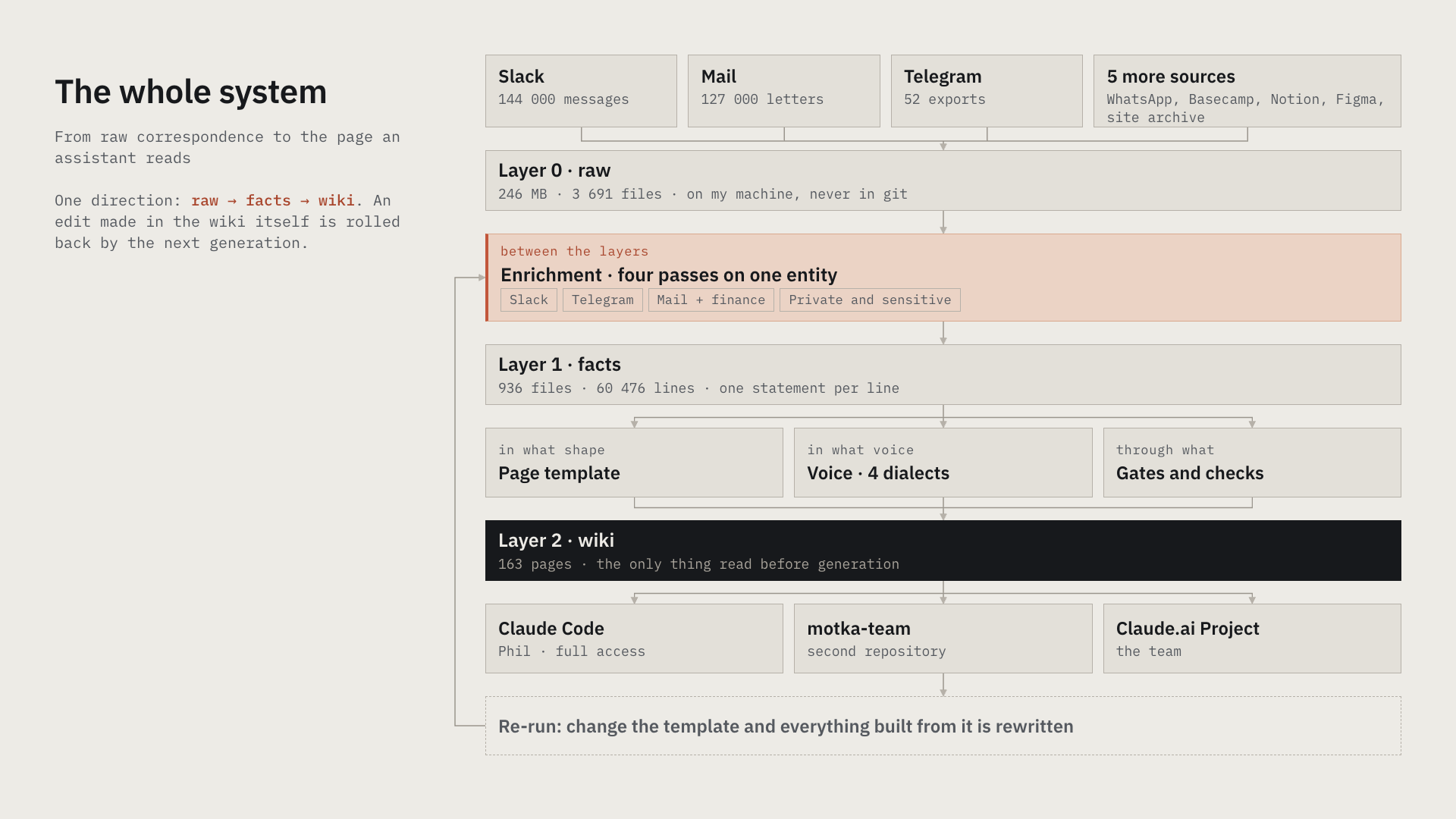
2. Layers of Truth
Layer 0
Raw data dumps
Email, Slack, Telegram, Google Drive, exactly as they came.
Lives on my machine only.
Never enters github.
Layer 1
Extracted facts
in machine-readable JSONL
1 precise claim per line, atomic, dated, attributed.
This is the layer you argue with and the layer you fix.
Layer 2
Wiki: prose, based on facts
Nothing here is typed by hand.
Every page is generated by rules, and can be regenerated.
One direction only: raw data → facts → wiki.
Fix the error in the facts, never in the wiki. An edit made in the wiki comes back on the next generation. This is the rule everyone breaks first when they try to rebuild this.
936
fact files
60,476
fact lines
1,199
entities
163
wiki pages, 85 project pages
3. Wiki Structure
Indexes
(human & machine readable)
projects
clients
persons
years
cases
pages
claude.md
Project
85 dedicated pages + 142 short blocks
Meta, disambig, TL;DR
Project origin
Scope and deliverables
Timeline
Finance
Client contacts
Motka team
Quotes & highlights
Failures and lessons
Outcome, case, Figma trace
Person
16 personal pages + team page
Meta, disambig
How they joined
Current role
How to work with them
How they think / communication style
Projects at Motka
Strengths
Growth areas
Quotes
Highlights, bonds, outlook
Year
22 pages across 2005–2026
Meta
Timeline by quarter
Portfolio of the year
Finance
Team
Studio events
Quotes of the year
Handover → next year
Marketing Strategy
Marketing, Positioning, Case studies, Services, Clients profile
Internal backbone
Process, Principles, How we design, About us, Tone of voice, Team
Experiments
Patterns, Insights, Team analysis, Our internal projects, Friends/partners
4. Entities.db — Who Is Who?
| id | canonical_name | type | aliases | period · segment |
|---|---|---|---|---|
| 3 | Maria Yekimova | person_core | Masha · Masha Maksimova · Маша · yoyo | 2014 → now |
| 118 | Leverate | company | Leverate · Lever · леверейт | 2024 → 2026 · B2B fintech, CFD platforms |
| 1221 | Sirix | product → Leverate | Sirix CFD · Sirix TP | 2024 → 2026 · CFD trading platform |
| 120 | MTX | company | mtx · MTXC · MTX Connect S.A. · mtxc.eu | 2024 → 2026 · eSIM, telecom |
| 42 | Algoritmika | company | Алгоритмика · Algorithmics · Algo · Logika | 2020 → 2022 · EdTech franchise, branding |
Where it starts
A short list of projects and people, written by hand. That list is the key — everything after it hangs off the key, and the table fills itself while the model reads mail and Slack.
What it resolves
Brand names, legal names, domains, product lines, nicknames, Cyrillic spellings of Latin brands. Which product belongs to which company. And which remark in a thread belongs to which project.
Disambiguation: 3 people, 1 name
Ilya → #7 · PM at Motka since 2025
Ilya → #549 · client side, Leverate intro
Ilya → #19 · client side, GT alumnus, 2015
Miss this and the wiki gets a person stitched from 3 people.
Attribution is laid first, or the error ends up in every fact, page and link
5. Enrichment: How a Page Gets Into the Wiki
1. Synonym list — every name this project was ever called
2. Source map — where it could possibly be written about
3. Extraction brief — what exactly we are looking for
Multiple Layer 0 read passes run in parallel over the same entity
Slack
Telegram + WA chats
Email (with financial sub-pass)
DMs and anything sensitive
People speak 1 language in a public channel, another in email, a third in a DM.
Different passes with different instructions pull out different things and cross-check them.
Each pass also has findings (beyond the brief) and questions (asks me in the middle).
4. Facts handed to a writer, as a separate process
5. Wiki page written in our voice, through the template
6. Gates, rewrite, gates again — no green, no page
7. Backlinks drawn, neighbouring pages corrected
Every run branches first: generate from scratch, or re-generate in delta mode.
That branch is why the system keeps living instead of being rebuilt.
6. Gates + Checks
Email reading gate
- cut prompt injections hiding in spam
- slice the thread, drop quoted history
- pick what is worth reading at all with simple scoring
- from thousands of messages down to a handful
Facts writing gate
- secrets obfuscated before writing
- bans.jsonl — 57 ban conditions, not 57 banned facts
- a condition catches facts that do not exist yet
- clarifications.jsonl — 984 manual clarifications from a human
Wiki health check
- schema: frontmatter, wikilinks, slug filenames
- every quote checked against its source line
- money policy: orders of magnitude, no payouts
- page edits that must survive regeneration
Session gate
- pre-commit hook
- loss-check: what the new page dropped
- changelog and run history
- learning patterns, and the skill updating itself
Gates are an interface, not plumbing
“I don’t edit anything by hand. I say: ban that fact — and it finds every place the fact leaked into and takes it out.”
The trust curve
First I was reading all the output (every wiki page) → then read only relevant samples → now, barely read at all. I have 9 role models (angles) that Claude emulates when auditing pages. Not because I relaxed: because I now can fairly predict what comes out.
7. RAG Replication
motka-os
Tone of voice
General
Case study
LinkedIn post
Proposal
Meetings Transcriber
Site grabber
Facts enrichment
Wiki — written here, 163 pages
Tooling
JSON facts
Entities.db
Audit, logs, backups
Wiki templates
Seed
Raw 20 years, never leaves this machine
motka-team
Tone of voice
General
Case study
LinkedIn post
Proposal
Meetings Transcriber
Site grabber
Wiki
Nothing else replicates here.
No facts, no entities, no seed, no tooling.
GitHub
Motka Team members
Maria
Ilya
Elena
Elizaveta
Anna
etc.
We share the same repo.
After this our LLMs can read the wiki as local files — on Claude, on Codex, anywhere.
Initial setup on Phil’s local machine.
Everyone shouts how fast they built it.
Look closer — it’s a toy.
April → Fall 2026
Our wiki was a toy too
By the end of April coverage was 85% complete but quality was below anything I’d ship.
“The first project wiki page was great. Fine, now write 15 projects. By the 15th it was a mush.”
Quality falls apart over running distance, and it is fixed by process, not by a prompt: a separate session arc per unit of text: brief, process, ending gate.
So I did not roll it out
I rolled it out only to 2 managers, because they needed it most: inbound, the website, marketing, proposals.
Put it behind a shared project in Claude, so every chat inside it already carried the context. Loaded, not perfect.
And then it quietly started paying for itself for 6 months.
What has happened along the way:
got first clients for AI products
re-engineered our Webflow site on Claude
started transcribing 90% of calls
completely changed website copy
wrote posts on LinkedIn
voice dictation
improved copywriting on live projects
planned this trip
Meanwhile, in the design industry…
—
Clients now send AI briefs, AI mock-ups, AI feedback and finished prototypes, daily.
—
Nobody waits for a designer to draw anything any more.
The job changed: extract signal from slop.
—
New rule: never hand a teammate an AI deliverable without validation, or without your own comment on it.
—
A 3-page AI generated brief from the client has to be condensed by a human down to what actually matters.
—
Between 2 designers the prototype travels, not the tooling context. The prototype is itself the project, the documentation and the context.
“AI did it” ban
“AI did it” is not in the vocabulary. You shipped it, you made it. Only “I did it with AI” — or “a client sent this and I didn’t check it”.
I think this came from the CLAY agency and we adopted it in Motka. Reading a document must take less time than producing it.
during 2026
While I was building the wiki, Figma caught up
summer-fall 2026
Old projects
Stayed on manual for a while. Years of context nobody ever fed to a model, and feeding it retroactively costs more than it returns.
New projects
They start with AI from day 1. Some older clients also used this approach for newer projects/functions.
Figma stopped being the place where UX is born
Now most projects start with an HTML prototype. We iterate on it, sometimes drawing particular details in Figma, but then converging everything into HTML. In the end a clean Figma file with a design system is generated out of it by pressing a button.
Before
A client brief + scattered docs
Kick-off call sets the task
Designer listens to the recording and assembles first draft
Show, feedback on a call, iterate internally until ready
Present to a client, they send feedback to the manager
Manager curates feedback for the designer, and round starts again
Now
Call recordings + any number of docs
Load into Claude, get a clear task list
Claude creates design in Figma on the task list
Designer verifies with Claude, internal call, iterate until ready
Present to a client, get feedback, load into Claude, round starts again
Wiki Rollout
early November
Everyone read their own page first.
Then they started asking it questions — about themselves, about where they are going.
“It feels like someone made a documentary about 20 years of our lives.”
Corrections started arriving the same day, and they are already in.
The genuinely hard part was syncing over git.
Not the model, not the corpus. The plumbing.
Now you can have a real conversation with AI
Not “find me a case”. Where the company is going, what we are actually good at, what to do next.
And the answers come back worth arguing with.
The sharpest things it told me about our positioning I am not going to repeat on a stage.
What is the practical value?
—
12 months of tough practice with AI tools
Not opinions about AI. We know what breaks, what holds, and how fast a tool you built becomes a feature someone ships.
—
20 years of business, finally seen from the outside
We read our own company the way a stranger would — and ended up owning what we had done.
—
Relevant competence that has just ripened
In August two new projects arrived that wanted exactly this. For one of them we grew a system a level above our own — and learned that this method transfers even for an enterprise-scale CRM.
—
Fully machine-readable Motka
For Claude, for Codex, for whatever comes next our business is now fully readable and transparent. My guess is that it has helped us also with AI search optimization (LLM SEO).
+
Designers use LLMs to design in Figma
Each designer independently created his own personal working pipeline (Claude, CLI, Figma AI)
What didn’t work
The load went up, not down
“I’m supposed to be reducing my load, and instead I’m wading through a stream of sludge.”
It invents a lot of work for itself
It tells me the drafts need re-rolling. And there is no way to say: leave it. Add to that the tooling that constantly needs maintenance.
Not everyone got along with it
1 person moved to Codex, 1 designer prompts Figma AI directly, and 1 still says: the less of it in my life, the better.
Things I simply don’t know
When the system starts to bloat or drift, I have no idea. We just keep it tight and hope we notice what’s going on.
The TOV still doesn’t write itself
The moment it turned was when I stopped expecting it to write instead of me, and started writing with it. Like a ball against a wall: eventually you learn the bounce.
Calls-to-Tasks aren’t fully automated
The dream: you leave a call, go make tea, come back to a first version and give feedback to an agent that keeps going.
Motka Design Studio
https://motka.design
Thoughtful UX/UI and awesome branding since 2005.
If you have a design problem that needs this much care taken over it — contact us.
Questions?
We were afraid of being replaced by AI.
So we ran the lab on ourselves.
Now we have 7 different answers to this FOMO
and 1 shared context.